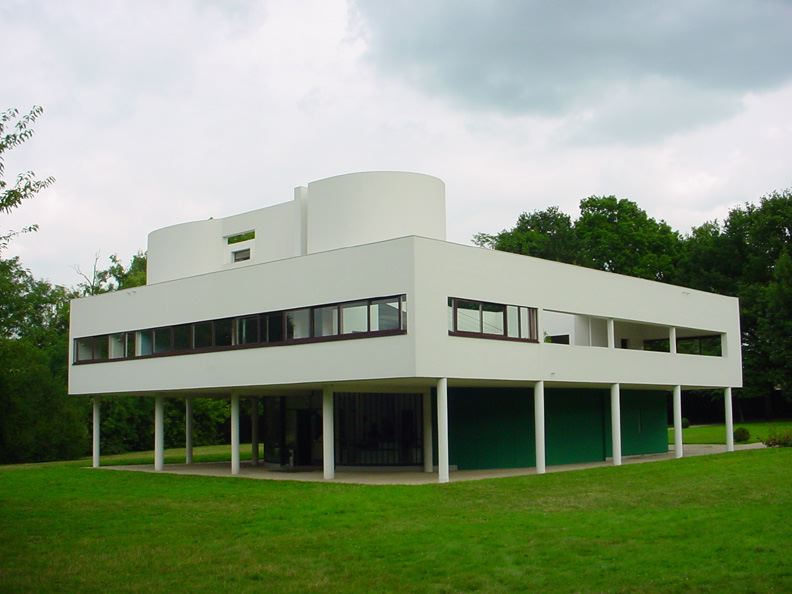
Le Corbusier, born Charles-Édouard Jeanneret in Switzerland, became one of the most widely discussed architects and theorists of the twentieth century. His work addressed private houses, housing blocks, cultural and religious buildings, and plans for cities.
Architecture as a set of propositions
Rather than regard building design as the repetition of inherited forms, Le Corbusier published proposals about structure, light and modern living. His Five Points of a New Architecture include pilotis, roof gardens, free plans, free façades and horizontal windows.
Villa Savoye in Poissy makes the points legible in one building. The raised main volume creates space for movement beneath; a ramp organises the journey through the house; and roof-level outdoor space is integral to its design.
Buildings beyond the manifesto
Le Corbusier’s later work is not confined to the white geometry of Villa Savoye. His work includes the Unité d’habitation in Marseille and the Chapel of Notre-Dame-du-Haut at Ronchamp, whose appearance differs radically.
UNESCO’s serial inscription covers seventeen component sites across seven countries. It recognises his contribution to the international exchange of modern architectural ideas, not an endorsement of every proposal he ever made.
The key connection
Read Villa Savoye as both a visual manifesto and a dwelling. The contrast between these two roles is central to a thoughtful account of Le Corbusier’s legacy.
A famous house, unhappy clients
The official Villa Savoye visitor site preserves a less celebrated side of its history: the Savoye family raised problems about construction defects soon after moving in, including leaks affecting the ramp, garage and bathroom. This is not a later critic projecting modern tastes onto the building; it reflects contemporaneous complaints from clients.
Pierre Jeanneret also worked with Le Corbusier on the project and its cost estimates. Popular histories built entirely around Le Corbusier’s heroic individual genius omit part of the working context.
An architect is not a manifesto
The power of the Five Points lies in their clarity, yet actual houses must satisfy maintenance, weather protection and daily use. One should not confuse the elegance of a diagram with the success of every construction detail.
Equally, the defects of a specific commission do not invalidate the whole body of work. Critical assessment means being able to acknowledge major creative influence and document failures at the same time.