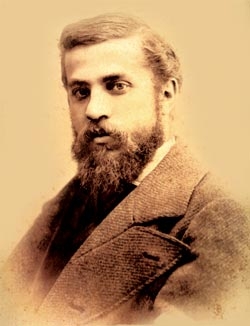
Antoni Gaudí is closely associated with Barcelona, where his buildings made architecture, structure and decorative art part of a single creative language. Rather than applying an established style uniformly, he developed solutions specific to a site’s use, materials and setting.
Architecture beyond the façade
Gaudí’s work draws attention to structure as well as surface. Walls, columns and openings do more than define rooms: their shapes contribute to the character of a building. Colour, ceramics, ironwork and sculptural detail often participate in the same composition.
This approach makes a project such as Casa Batlló difficult to understand as merely a decorated house. Its exterior, interior and circulation form parts of a coordinated redesign.
A figure within Modernisme
Gaudí belongs to the wider world of Catalan Modernisme, a cultural movement associated with the flourishing of Barcelona around the turn of the twentieth century. But he was not interchangeable with other architects of the movement: the highly individual form of his work is one reason it became internationally recognised.
UNESCO’s World Heritage listing, Works of Antoni Gaudí, includes seven places in and around Barcelona. Among them are Casa Batlló and Gaudí’s work on the Nativity façade and crypt of the Sagrada Família.
Following the connections
To explore Gaudí’s contribution, start with Casa Batlló for a residential building transformed through renovation, then move to the Sagrada Família for a project developed over many decades. Together they show how an architect’s ideas can operate at very different scales.
The risk of a solitary-genius story
Gaudí’s work is frequently presented as if an extraordinary individual had created buildings outside ordinary history. UNESCO’s account places the projects within both Catalan cultural identity and the technical innovations of their era. A more useful question is what the architect transformed from that environment, rather than whether he was simply unlike anyone else.
The UNESCO recognition is also selective: it covers seven specified properties, not every structure ever connected with Gaudí. In the Sagrada Família, the inscription applies to his Nativity façade and crypt, not to the whole changing church.
Context matters as much as ornament
Casa Batlló was the substantial redesign of an existing apartment building. Describing it as the spontaneous expression of an isolated artistic imagination overlooks the real conditions of a client commission and the existing urban structure.
Critical history can admire the building while refusing to treat its architect’s fame as sufficient explanation.